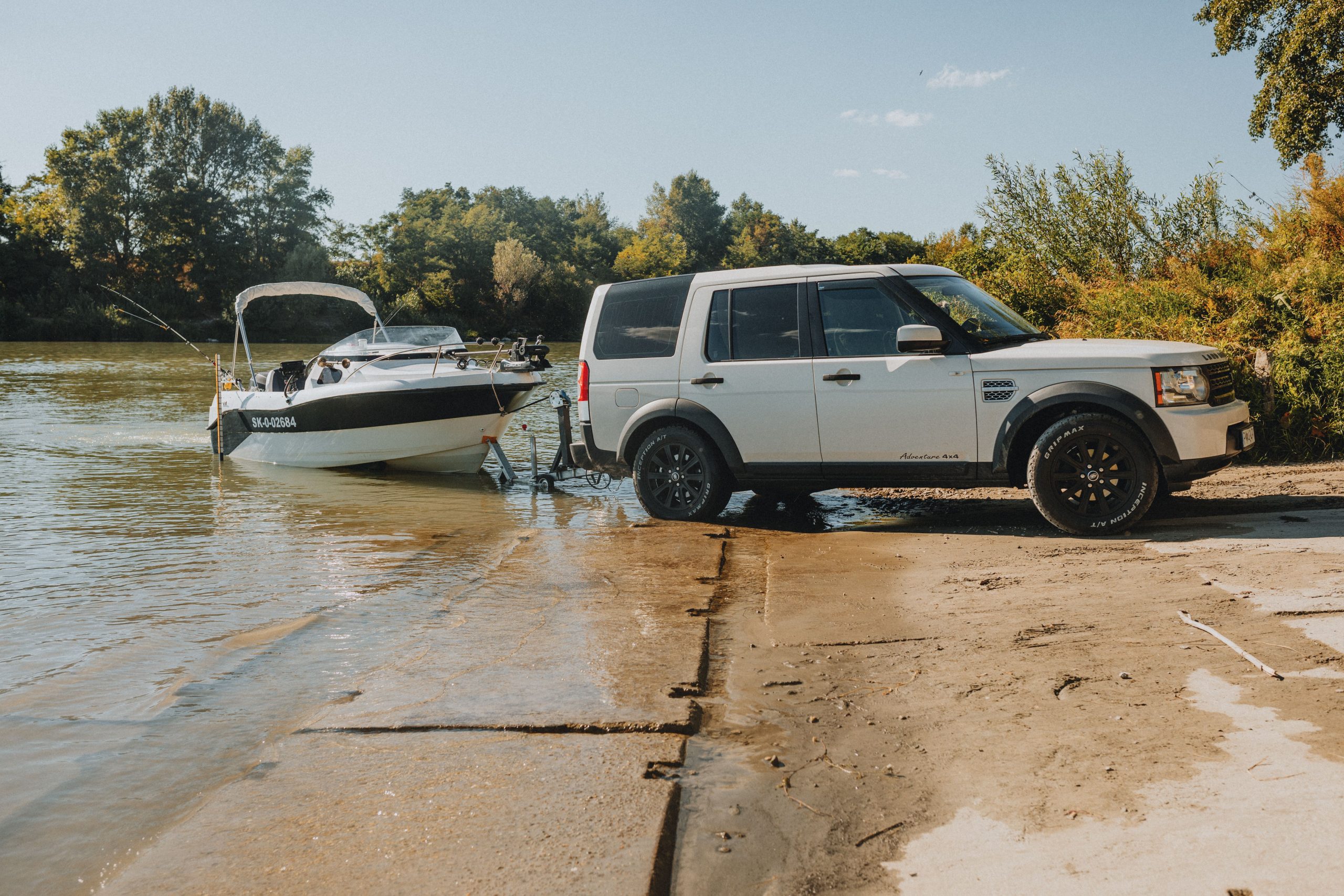
SUV towing capacity is the maximum trailer weight a manufacturer says a vehicle can pull, and it is one of the most misread figures on a spec sheet. Buyers treat it as a promise. It is closer to a ceiling measured under conditions that almost nobody drives in, with an empty vehicle, two people aboard, and a trailer loaded exactly to the assumption in the test.
The gap between that ceiling and what an SUV can safely pull on a hot Tuesday with four passengers, a roof box, and a full tank is where trouble starts. Anyone shopping for a tow vehicle, or wondering whether the SUV in the driveway can handle a boat, needs to understand the number underneath the number.
What SUV towing capacity measures
Towing capacity, or trailer weight rating, is not a figure a manufacturer invents. Since the early 2010s, most automakers rate tow vehicles to a shared industry test. SAE International’s J2807 standard sets minimum performance criteria and a calculation method for gross combination weight rating and trailer weight rating, covering vehicles up to 14,000 pounds gross vehicle weight rating. It was reaffirmed in November 2024.
Before that standard, each automaker graded its own homework. Comparing a Ford rating against a Toyota rating was close to meaningless because they measured different things with different assumptions. J2807 fixed that by making every manufacturer run the same gauntlet: acceleration to 30 mph inside a set time with the trailer attached, a sustained climb up the Davis Dam grade in Arizona without overheating, launch from a stop on a 12 percent incline, braking distance, handling and sway response, and structural loading at the hitch.
That history matters for used SUV shoppers. A tow rating on a 2009 model was not produced the same way as one on a 2019 model, so an older vehicle with an impressive brochure figure may be less capable than a newer one with a lower published number.
The ratings that constrain SUV towing capacity
SUV towing capacity rarely acts alone. Four other numbers sit alongside it, and in real use one of them usually runs out first.
Payload is the total weight of everything the SUV carries: passengers, luggage, roof cargo, aftermarket accessories, and the trailer’s tongue weight pressing down on the hitch. This is the limit most families hit. A three-row SUV loaded with five people and holiday luggage can eat its payload before the trailer is even connected.
Tongue weight is the portion of the trailer’s weight bearing down on the hitch ball, typically 10 to 15 percent of the loaded trailer for a conventional hitch. J2807 assumes 10 percent for its calculations. Get this wrong in either direction and handling suffers. Too little and the trailer sways. Too much and weight lifts off the SUV’s front wheels, which dulls steering and braking.
Gross vehicle weight rating is the maximum the loaded SUV itself can weigh, and gross combination weight rating is the maximum for the SUV and trailer together. GCWR is the one people forget. A vehicle can sit under its own GVWR and still put the combination over the combined limit.
Gross axle weight rating caps what each axle can carry. Tongue weight lands mostly on the rear axle, which is why a heavy trailer plus a loaded cargo area can overload the back of the vehicle even when everything else looks fine on paper.
The practical rule: the lowest of these limits is the real limit. A tow rating of 5,000 pounds means nothing if payload runs out at 900 pounds and the family plus gear already weighs 800.
Why the brochure number is not your number
Published SUV towing capacity assumes one specific configuration. The test vehicle carries a driver and a passenger at 150 pounds each, plus an allowance for hitch equipment, and nothing else. No third-row passengers. No cargo. No roof rack loaded with bikes.
Trim and drivetrain change the figure too. A tow rating is usually tied to a particular engine, axle ratio, and sometimes a factory tow package with an upgraded cooler, wiring, and hitch receiver. The 5,000 pound number on the manufacturer’s website may belong to a version with options the SUV in question does not have. A dealer listing that quotes the model’s maximum rating without checking the build is not lying so much as being unhelpful.
Conditions matter as well. Heat, altitude, long grades, and headwinds all put more strain on a drivetrain than the flat-road numbers suggest. Many experienced tow vehicle owners work to about 80 percent of the rated maximum for exactly this reason. That is not a rule anyone publishes. It is margin, and margin is what keeps a transmission alive on a long climb in August.
Electric SUVs add their own wrinkle. Most tow well because of torque, but pulling a trailer can cut usable range dramatically, sometimes by a third or more. Anyone planning to tow an electric SUV over distance should plan charging stops around the towing range, not the brochure range.
SUV towing capacity by vehicle class
Broad ranges are useful for narrowing a search, though the owner’s manual always wins over any general figure on SUV towing capacity.
Subcompact and compact crossovers usually sit between not rated at all and about 3,500 pounds. Many are unibody vehicles with modest cooling, fine for a small utility trailer or a pair of jet skis and not much more.
Midsize crossovers with a tow package typically land between 3,500 and 5,000 pounds. That covers a small travel trailer, a mid-size boat, or a car hauler with a light load, provided payload allows it.
Body-on-frame midsize SUVs, built on truck platforms, often reach around 5,000 to 6,000 pounds and handle sustained work better than a comparable unibody vehicle because of the frame, cooling, and gearing.
Full-size body-on-frame SUVs are the serious end. Ratings commonly run from about 7,000 to over 9,000 pounds depending on drivetrain and axle ratio. Buyers looking at full-size options like the Chevrolet Tahoe are usually there because payload and combined weight ratings, not just tow ratings, give them room to work with.
The pattern behind those numbers is construction. A body-on-frame SUV generally tows heavier and more comfortably than a unibody crossover of similar size, because the frame carries hitch loads differently and these vehicles tend to come with stouter cooling and braking.
Hitch equipment and the parts that fail first
The hitch carries its own rating, and it caps the setup regardless of what the SUV towing capacity allows. Receiver hitches are sold in classes, and while exact figures vary by manufacturer, the general pattern runs from Class I and II for light loads up to roughly 3,500 pounds, Class III for most midsize and full-size SUV towing up to around 8,000 pounds, and Class IV and above for heavier work. The ball mount and hitch ball carry separate ratings too, and a mismatched ball is a common and avoidable failure point.
A weight distributing hitch spreads tongue weight across both axles of the tow vehicle and the trailer axles, which restores steering feel and levels the vehicle. Many manufacturers require one above a certain trailer weight before the full tow rating applies. That requirement lives in the owner’s manual, and ignoring it can technically void the rating.
Trailer brakes are the other piece. Requirements vary by state, commonly kicking in somewhere around 3,000 pounds of trailer weight, and an SUV towing anything substantial usually needs a brake controller. Relying on the vehicle’s brakes alone to stop a loaded trailer is how stopping distances triple.
Tires deserve more attention than they get. Towing raises the load on every tire, and underinflation under load builds heat. NHTSA’s tire safety guidance points owners to the Tire and Loading Information Label on the driver’s door edge or B-pillar for the correct cold pressure, and notes that tires show damage from overloading and underinflation. The agency recorded 511 deaths in tire-related crashes in 2024. Checking pressure before a towing trip takes two minutes.
A pre-tow checklist
- Confirm the SUV towing capacity for that exact build in the owner’s manual or on the door jamb label, not from a generic model page
- Weigh the trailer loaded at a public scale rather than trusting the dry weight from the brochure
- Add up passengers, cargo, accessories, and tongue weight, then check the total against payload
- Confirm the combination stays under GCWR, not just under the tow rating
- Match the hitch class, ball mount, and ball to the load, and fit a weight distributing hitch if the manual calls for one
- Set tongue weight at roughly 10 to 15 percent of loaded trailer weight by moving cargo forward or back
- Check whether the trailer needs brakes in the states being driven through, and fit a controller if so
- Set cold tire pressures to the door label figure, including the spare
- Verify lights, safety chains, and the breakaway cable before every trip
Frequently asked questions
How do I find my SUV towing capacity?
Start with the owner’s manual for the specific model year, engine, and drivetrain, then check the certification label on the driver’s door jamb for GVWR and axle ratings. Manufacturer towing guides for that model year are the next best source. Generic figures on listing sites often quote the highest rating available for the model rather than the one that applies to that build.
Can I exceed SUV towing capacity a little bit?
It is a bad trade. Overloading stresses the transmission, brakes, cooling system, and hitch structure, and it lengthens stopping distances at the worst possible moment. It can also affect an insurance claim after a crash. If a load is close to the limit, the safer move is a lighter trailer or a more capable vehicle.
Does towing damage an SUV?
Towing within the SUV towing capacity and the related weight ratings, with the right equipment and maintenance, is what these vehicles are built for. Damage tends to come from repeated overloading, skipping transmission fluid changes, or towing heavy loads on a vehicle without adequate cooling. Shortening service intervals when towing regularly is sensible.
Is SUV towing capacity different for four-wheel drive?
Often, yes, and not always in the direction people expect. Four-wheel drive adds weight, which can reduce payload and sometimes the tow rating, though it usually improves traction on wet ramps and loose surfaces. Axle ratio frequently matters more than drivetrain, which is why two otherwise identical SUVs can carry different ratings.